
Everyone Is Back in School Now
AI can accelerate the now. Human capability determines what comes next.


It’s the last week of July, and if you have kids or work anywhere near a school you can already feel it: the back-to-school rhythm is starting. Supply lists, campus move-ins, first-day outfits, orientation schedules, awkward pictures for first day of school. We do this every year, and every year it carries the same quiet assumption, that school is something you go back to, a place with a start date and an end date and a population that ages out. I want to challenge that assumption, because I think back-to-school now means something different than it used to, and it applies to all of us.
Last week in Des Moines, after I finished a talk at an all-company meeting, an attendee walked up and asked me a question I keep chewing on:
“Is my degree, no matter what it is, still worth it?” He said this with a feeling of rejection yet bravery he wanted to prove it was.
He was asking if the time, money, and effort already spent would still matter in a world moving this fast.
Before nearly every AI conversation I’m in these days, someone asks a version of the same thing. A CEO wants to know what we should be teaching people now. A parent wonders whether college is still the right bet. A professor asks what belongs in the curriculum. A CHRO asks how to prepare a workforce when the work itself keeps changing. A recent graduate wants to know how to get experience when the jobs that used to provide it are being redesigned in real time.
The words differ but the question underneath is the same one.
How do we prepare humans for an AI-native world?
It’s become personal for me in a way I wasn’t expecting. I’m building courses for the College of Charleston, where I’m teaching again this fall, my youngest, Alex, is getting ready to start college. My oldest, Ben, is 21 and learning on the job in Austin, where the curriculum isn’t printed in advance and the next lesson usually shows up disguised as a problem. Then last night, my mom asked me over dinner what would need to change in education, and because she spent her career as an educator the question landed in a different key. I told her school can no longer be the only place we expect learning to happen, and graduation can no longer be the moment we call preparation finished. A degree showing you finished wont promise you a job. You don’t just learn at school and then go to work. That line doesn’t exist anymore. She didn’t argue. She just got quiet (which is rare), which is how I know she agreed.
Fear runs under most of these conversations, not panic exactly, more a hum of uncertainty. People sense the map has changed and the institutions around them are still handing out the old directions. People nod in sessions but no one has the answer and I don’t think we should.
I don’t want to feed the fear, and I don’t want to calm anyone with a slogan either. “Keep learning” is fine advice and no longer enough, and telling someone their degree doesn’t matter is careless and wrong. Education still matters, and so do depth and the discipline of learning something hard. But no credential, whatever it says on the paper, can permanently complete our preparation.
Send this to someone you’ve had this conversation with in the last three months. The one that ended with both of you shrugging.
The line has blurred
For decades, the model ran as a straight line: you learned first and worked second, education happened in school, experience happened on the job, and over time you developed judgment.
That line has been bending for years. AI didn’t start the change, but it pulled the mismatch out into the open where nobody can pretend anymore.
The dominant frame right now is that AI is a tool and people just need to learn to use tools. It sounds reasonable and it’s dangerously incomplete. A hammer doesn’t change what your arm is capable of when you put it down. AI is different because it can do part of your thinking, and using it over time changes what you’re capable of thinking on your own. I don’t think most people have sat with that long enough.
Work is more like a stage you step onto than a page you read. Capability grows when you perform in front of consequence, when someone watches, something is at stake, and the response of the room teaches you what no manual could. That’s the mechanism behind tacit knowledge, judgment, and taste.
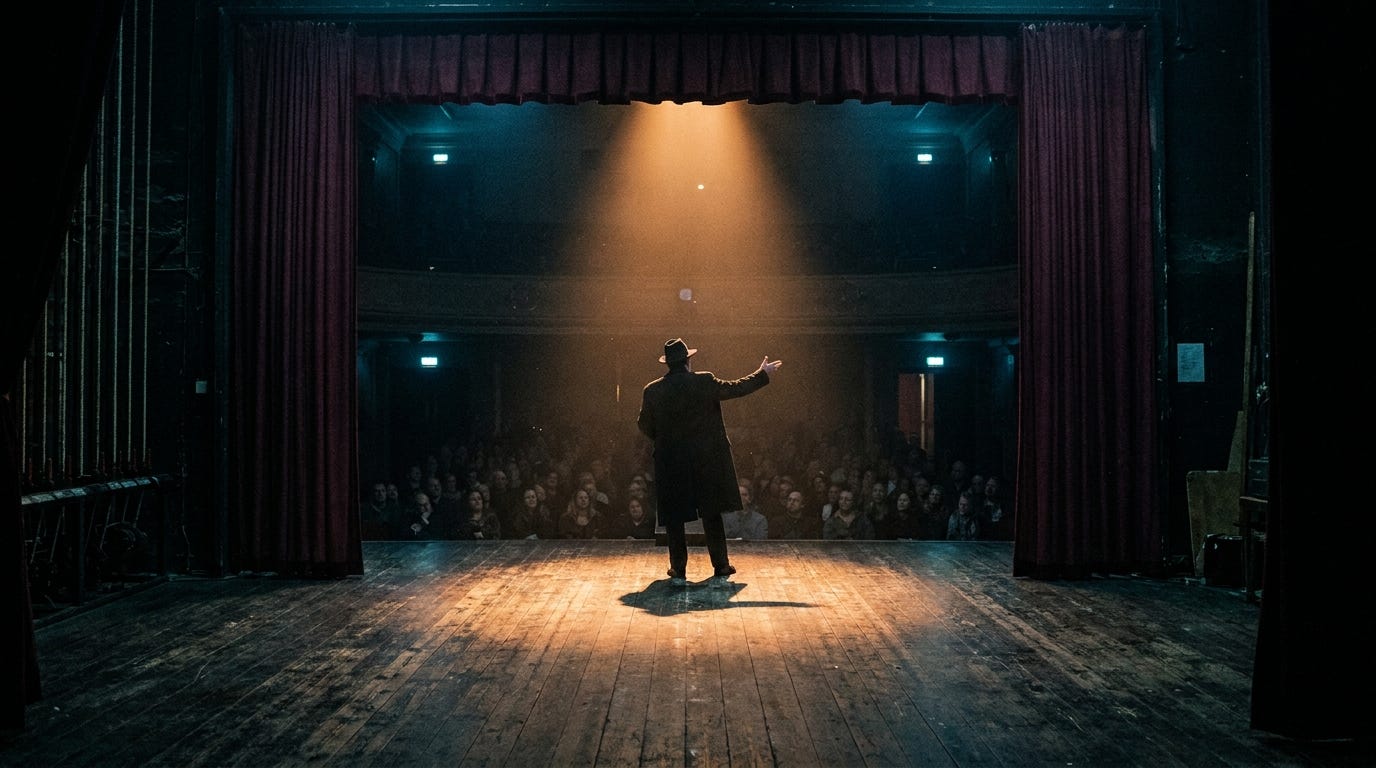
Taste deserves its own moment because most people underestimate it. Taste isn’t personal preference. It’s cultivated discernment, the ability to tell fluent from true, competent from excellent, and technically possible from humanly worthwhile. You don’t download it like a Claude Skill. You build it the same way you build everything else that lasts: by watching people who have it, attempting the work yourself, getting it wrong, and slowly (sometimes painfully) learning to see what you couldn’t see before.
Amy Edmondson has spent decades studying the same dynamic from a different angle. Teams learn when people feel safe enough to make visible mistakes in front of each other, which is stage work by another name, and it’s exactly the mechanism AI can quietly dismantle if nobody’s watching.
Schools used to be the wings and then you got to work and it was the stage, and you rehearsed in one and performed in the other. Now the wings and the stage have collapsed into the same room. Knowledge can be accessed, summarized, translated, and applied at machine speed, and many tasks that used to demand a person start from a blank page no longer do. The first draft, first analysis, first code, first pitch: all of it can now be produced with AI standing at your shoulder.
That doesn’t make knowledge irrelevant, it changes what a person has to do with it. When answers are cheap, the quality of the question even matters more, and when drafts are cheap, judgment about what’s true, useful, responsible, and worth doing becomes even more valuable. Machines can generate part of the work, but someone still has to decide whether the work is solving the right problem in the first place.
Judgment isn’t downloaded with the answer. Neither is taste, and neither is the tacit knowledge you only get by stepping onto the stage yourself.
Better output, weaker workers
Most organizations right now are using AI to improve one thing: the now. Faster output, lower cost, higher throughput, all real and measurable and exactly what boards are asking about on every earnings call.
But the productivity gains won’t compound if the workforce gets faster while getting less capable, and I don’t think enough leaders are doing that math or work yet. Almost every executive conversation about AI is structured around a single number, the near-term productivity lift, and almost none are structured around the number that shows up eighteen months later, when the pipeline of experienced people who can actually do the work at a high level starts to thin out.
If short-term efficiency erodes judgment, weakens tacit knowledge, and/or removes the experiences through which future experts and leaders develop, the performance gain gets very fragile. Quality slips, risk grows, innovation slows. The organization becomes less able to adapt when the market or the technology moves again, which it will, and faster than last time.
AI that improves this quarter’s productivity while degrading next year’s capability is borrowed performance.
You can cut your way to a short-term stock price, but you cannot cut your way to sustained relevance.
I’m watching it happen. In the last year I’ve been inside organizations across industries that are compressing or eliminating their associate and analyst programs to fund AI tooling. The math looks clean on a slide: fewer junior people, same output, lower cost. But the senior leaders in those same organizations are already sensing something they can’t quite name. The questions in meetings are getting thinner, the pattern recognition is slower, and the bench is weaker. Nobody built a replacement, because the replacement was supposed to be the people who aren’t there anymore.
The first rung of almost every professional ladder (and if you’ve been in the workforce long enough, you remember standing on it) was never valuable only for the output it produced, it contained a hidden curriculum. The junior analyst building the spreadsheet also learned which assumptions mattered, why an experienced colleague challenged a number, and how a small error could alter a decision. The new consultant taking notes learned to read the room, separate what was said from what was meant, and recognize when the real issue was hiding behind the official agenda. That was proximity to consequence, and that was time on the stage.
If AI takes those tasks and nobody redesigns what replaces them, you’re cutting the mechanism by which your next generation of experts gets built. That’s a leadership decision and nobody else in the organization can make it for you.
The redesign isn’t abstract, by the way. It looks like structured judgment reviews where senior people walk juniors through the decisions that never made it into any memo, deliberate stretch assignments chosen for what they’ll teach rather than what they’ll ship, and “AI-off” work sessions where people practice thinking without the tool doing half the work for them. None of these are new. What changed is that they used to happen by accident, and now they have to happen on purpose.
What you’re no longer learning
Every leader I work with eventually gets around to asking a version of the same personal question, usually quieter than the strategic ones, something like:
“Is AI making me stupid?”
Honest question, wrong framing.
The sharper version is: what am I no longer learning because the machine is doing it for me?
A field experiment published in PNAS in 2025 (Bastani et al.) put nearly 1,000 Turkish high school math students through practice sessions with GPT-4. Students given a standard chat interface performed 48% better while they were using it, but when the tool was taken away they scored 17% worse than students who had never used it at all. A second version of the tool, designed with safeguards that pushed the student to work through the problem rather than hand back the answer, largely erased the drop-off.
One study, one setting, high school math. It doesn’t prove AI is weakening every knowledge worker, but it proves a distinction we can’t afford to miss: the tool can improve your performance in the moment without building the capability to perform when the tool is missing, wrong, or slow.
Better output and deeper learning aren’t the same thing. AI can rehearse for you, but it can’t step on the stage for you.
I know this from my own life. Early in my career I spent weeks building a business case for an HR technology decision and thought it was solid. I presented it to a room of leaders, and I could tell from the silence and the way people looked at each other that it wasn’t. Nobody needed to say the words. I went back and rebuilt it, and rebuilt it again, and somewhere in the third version I started to understand what I’d been missing, not the data but the logic underneath the data, the story the numbers had to tell to earn a decision. That lesson lives in me thirty years later, and I don’t know where it goes if AI generates the first three versions and the person in the room never has to feel that silence.
That’s the personal question every professional now has to answer. Which tasks are you handing to AI because it genuinely frees you to do harder, more human work? And which are you handing to it because the friction of doing them yourself is where your capability was being built?
Nobody outside your own head can answer that for you.
Everyone student, everyone teacher
I was on a call last month where a 28-year-old walked a room of senior leaders through an AI workflow that none of them had seen before, and you could feel the power dynamic in the room shift for about fifteen minutes. Then one of those leaders asked a question about how the workflow would interact with a regulatory constraint the 28-year-old had never encountered, and the dynamic shifted right back. Both of them were teaching. Both of them were learning. Neither one had the complete picture, and the only reason anything useful happened is that both stayed in the room long enough to find out what the other one knew.
That’s what the title actually means.
For most of my working life, “student” and “worker” were separate chapters. You were one, then the other, and the transition happened somewhere around 22. That’s done. From here on out you’re both, all the time, and so is everyone around you. The person just starting is learning context and teaching the room what’s newly possible, and the person 30 years in is teaching the discipline while learning why the playbook they trusted needs rewriting. Nobody graduates from either role. I certainly haven’t.
And the tidy generational story we’ve been telling ourselves doesn’t hold up either. Young people teach technology, older people teach wisdom. Sounds right but I think it’s VERY wrong, and it underestimates everyone involved. A student may see a possibility an experienced leader is too pattern-locked to notice, and the leader may see a consequence the student hasn’t lived long enough to recognize. Curiosity and resistance don’t belong to any generation, and neither does courage or judgment.
Which also means preparation itself has changed hands. It used to be a handoff: school prepared, employers hired, parents guided, individuals executed. Each institution owned its slice, and honestly, the line between them were where responsibility doed. Nobody had to own the whole problem because everybody could point at somebody else’s piece.
That model is done. Schools can’t finish a person, and a degree can’t future-proof a career. A company can’t outsource development and still expect a ready supply of experienced people to show up on time, and an individual can’t carry the full weight of reinvention while the organization redesigns work around them every quarter.
Nobody owns preparation anymore. Everybody shares it, and that’s uncomfortable because it removes the person you were going to blame. It is uncomfortable for HR and L&D; but it’s also true.
Now to Next
When I think about Alex heading to college, Ben learning on the job in Austin, the students I’ll teach this fall, and the leaders I sit with in boardrooms, I don’t see people at different points along one predictable path. I see all of us facing the same question from different starting points, and I include myself in that, because I’m figuring this out in real time too.
The individual version of the question is honest and small: what are you no longer learning because the machine is doing it for you? The organizational version is honest and big: if you’re using AI only to accelerate the now, you’re borrowing performance you’ll have to pay back, and the cost is the capability of your bench.
I think a big, visible split is going to open in the next eighteen to twenty-four months between organizations that designed for human development alongside AI and those that didn’t. The ones that invested only in productivity will start showing it in the quality of their decisions, the depth of their innovation, and the resilience of their teams when something breaks that the tool can’t fix. The ones that built people on purpose will pull ahead, and the gap will be obvious enough that the market notices. That’s not a prediction I’m making from the outside because I am already watching begin.
Use AI to extend the learning rather than eliminate it. Redesign what the first rung of every ladder was quietly teaching before the tool arrived, and talk to someone in a different role or generation than you about what we should be preparing one another for.
Everyone is back in school now because nobody is permanently prepared for what comes next. Nobody is behind, nobody is finished, and nobody gets from now to next alone.
If ANYONE ever wants to talk about this - drop me an email to jason@nowtonext.ai and would love to continue the discussion. Much love.
Let’s move together from Now to Next!
Next in the series: Learning in an Age of Abundance. When intelligence is everywhere, what becomes most important to learn?
About Jason
Jason Averbook is the co-founder of Now to Next, an adjunct professor of business, and a globally recognized thought leader, advisor, and keynote speaker working at the intersection of AI, human potential, and the future of work. He spent the last few years as Senior Partner and Global Leader of Digital HR Strategy at Mercer, helping the world’s largest organizations reimagine how work gets done, not by implementing technology but by transforming the mindsets, skillsets, and cultures that have to come first.
Over the last two decades, Jason has advised hundreds of Fortune 1000 companies and their leaders, founded Knowledge Infusion and Leapgen, authored two books on the evolution of HR and workforce technology, and become a world renowned keynote speaker who has delivered hundreds of talks on the future of work. His work challenges leaders to stop treating digital transformation as an IT project and start treating it as a human strategy.
Through his Substack, Now to Next, Jason shares honest, provocative, and practical insights on what’s actually changing in the workplace, from generative AI to skills-based organizations to emotional fluency in leadership. His mission is simple: to help people and organizations move from noise to clarity, from fear to possibility, and from now to next.
You can reach him at jason@nowtonext.ai or connect on LinkedIn.
The question you put to the reader - what stops being learned when the machine does it first - is one I hear in sessions constantly, but in career transitions the version is harder than skills alone. The uncertainty of not knowing what you actually want next, and having to stay in that question long enough to find out, is where self-knowledge gets built. AI handles the analysis efficiently. The person still has to discover which option is actually theirs, and that discovery takes time in the question the tool doesn't give them.
What does that look like in practice - in the organizations you're inside - when the redesign of learning actually happens?
100 percent!!