

I spent last week in Chicago, Toronto and Washington, DC, talking with CHROs and Chief Transformation Officers about AI and the future of work, and one concern kept coming up: how will people at the beginning of their careers get experience when AI can do more of the work we used to hire them to do?
While on the road, I also listened to Scott Galloway and Ethan Mollick on The Prof G Pod. Their conversation has been in my head all weekend because it connected with what I was hearing from leaders. We are getting better at identifying work AI can do, but I do not hear the same clarity about how we will develop the people who once learned by doing that work. As someone who teaches, works with employers and is a parent, I find that gap increasingly difficult to ignore.
What worries me is how quietly we can lose those opportunities. A company does not have to announce layoffs to close the door on a beginner; it can simply decide not to hire one. The internship never gets posted, the first-year role never gets approved, and the manager hands the assignment to AI. Somebody loses a chance they never knew existed, while the company sees work getting done and a cost it no longer has to carry.
The first job that never gets posted is a future we never give someone the chance to build.
I think we need to recognize this as an early-career crisis that can deepen while our productivity numbers improve. If enough organizations remove first opportunities without building new ways for people to learn, we risk weakening the system that produces future experts, managers and leaders. By the time that becomes obvious, we may have missed years of development, and those years cannot simply be handed back.
This should concern every country, and it reaches well beyond college graduates. Apprentices, people starting work without a degree and people changing careers all need a place to begin. The question is how we give them meaningful experience as the work itself changes.
Think about how you became good at something
For many of us, the first job involved work we would happily never do again. We drafted something, got it marked up, tried again and eventually understood why the experienced person kept changing it. Sometimes the feedback was helpful, and sometimes we learned despite the person giving it, but the repeated attempts gave us something to build on.
Mixed into that work was what I call tribal knowledge: what good looks like, when an answer feels wrong, which question somebody is avoiding, and when to stop following the process and ask for help. You rarely picked all of that up in a training course or during onboarding. You learned it through practice and through other people, gradually developing the judgment that some of us would call the beginnings of wisdom.
Mollick’s concern is that AI can interrupt both sides of that arrangement. A beginner can use it to produce an answer without working through the problem, while a manager can use it instead of giving the beginner the assignment. The work gets completed, but the experience that helped someone learn may disappear. I understand why that looks attractive when the immediate goal is a faster result, yet it leaves us with a responsibility we have not fully worked through.
Of course, plenty of junior people spent too much time on busywork and received too little coaching. We should improve that rather than preserve it out of habit. But when we remove a task, we need to understand whether we are also removing an experience that helped somebody grow and, if so, decide where that learning will happen instead.
A recent working paper by David Autor and colleagues studied patent lawyers over three months. AI improved drafting performance, with larger benefits for junior lawyers, but on a later task completed without AI, the improvement in professional judgment was concentrated among senior lawyers. The juniors showed no average gain, although their individual results varied. In that setting, the people whose output benefited most did not show the same average improvement in unaided judgment.
A study of high school mathematics students found a related problem. Students using a standard GPT-4 interface did better during supported practice but scored 17% lower than the control group when they subsequently worked without it. A version designed to provide hints and protect learning largely avoided that decline, which is encouraging because it shows that the way we design the experience matters.
Neither study tells us what happens in every workplace, but both give us a reason to look beyond the quality of the deliverable. When a junior employee hands you an impressive report, you still need to know whether they can explain the recommendation, recognize an assumption that does not fit and handle a follow-up question from a customer. Those are capabilities we need to help them develop, even when AI makes the report easier to produce.
Better output is only progress if we are also building the judgment to stand behind it.
The role can change, but somebody still has to learn
Take a new recruiter as an example. I want that person learning how AI can help draft a job description, organize information and prepare interview questions. But imagine a hiring manager asks for ten years of experience for a job that does not need it. The important learning opportunity is in understanding what the team actually needs and knowing how to challenge the request without damaging the relationship. A beautifully written job description can still describe the wrong job.
A more experienced colleague could sit with the recruiter, compare the AI draft with the business need and ask what they would change and why. That gives the beginner a chance to make a call, explain it, receive feedback and try again. AI helps with the assignment, while the assignment still develops the person’s judgment.
This is what I mean by redesigning work. Removing the drafting task is one decision, but we also have to decide what the person should learn, what responsibility they can safely take on and who will coach them. We may even question whether the recruiter role should exist in its current form. If we change or retire it, we need to be equally deliberate about where its valuable responsibilities and opportunities to learn will move.
The warning is already showing up in hiring. Stanford researchers, using payroll data through June 2026, found that employment among 22- to 25-year-olds in AI-exposed occupations was 19% below where it would have been had it kept pace with their less-exposed peers. The gap operated primarily through reduced hiring. The researchers describe these as early indicators rather than causal estimates, and they found no widespread economy-wide displacement.
That distinction matters, but so does the mechanism. It is easier not to hire someone than to fire them, and a job that never opens is much less visible than a layoff announcement. In a Gartner survey of 110 heads of HR, 22% said at least one business leader in their organization had stopped hiring for entry-level roles because of AI automation. To me, that is a serious signal at a time when so many leaders are still figuring out how to use the technology.
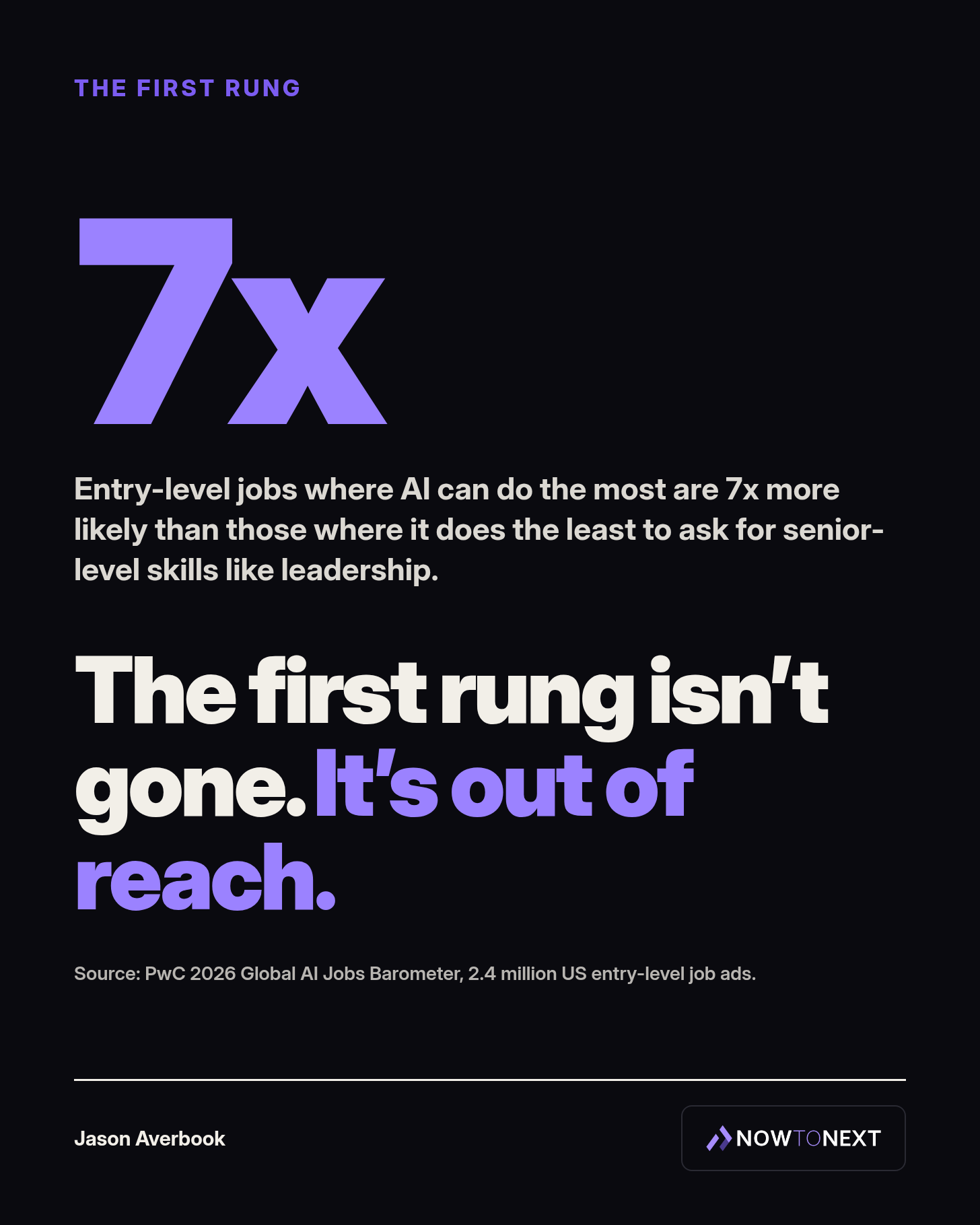
There is opportunity too. PwC’s analysis of US entry-level job ads found that roles most exposed to AI were seven times more likely to request skills traditionally associated with senior people, including leadership and creativity. Those roles had also grown since 2019, so the picture is more complicated than first jobs simply disappearing. The expectations are changing, and asking more of beginners creates an obligation to help them get there.
A sports team that stops developing young players may save money this season, but eventually it needs people who are ready to step in. If they are not coming through its own system, it has to compete for the same experienced players everybody else wants. Companies face a similar choice when they assume they can leave development to someone else and hire experience later. If enough employers make that decision, where will the experienced people come from?
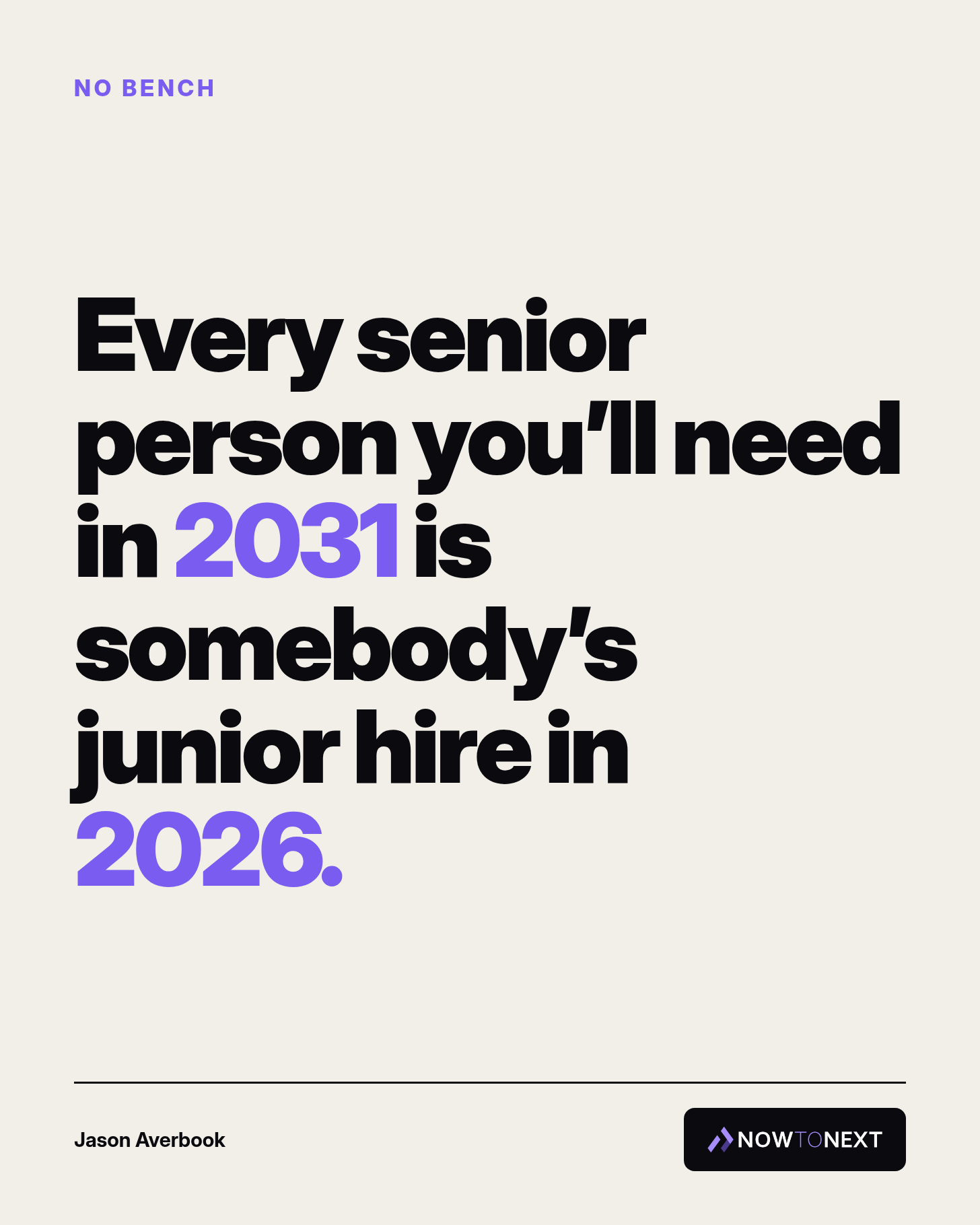
The people you will need in five years need somewhere to learn today.
May 2027 is closer than our plans suggest
I am especially concerned about students graduating in May 2027 because they are preparing for a workplace that continues to change while they finish their education. Some may enter organizations that expect them to work with AI agents capable of carrying out multiple steps, using tools and acting across systems. That requires practice defining an assignment, deciding what an agent is allowed to do, inspecting its work and taking responsibility for the result.
A student who has used a chatbot to produce an essay has not necessarily practiced those capabilities. Where schools still broadly prohibit AI without providing supervised ways to learn it, students may have even fewer opportunities to work with current technology. I worry that we will send some graduates into work with a widening gap between what they have practiced and what an employer expects, then tell them it is their responsibility to catch up.
I want students to do some work without AI so they develop their own reasoning, and I want them to learn how that reasoning guides increasingly capable technology. Both require practice. As someone who teaches at the College of Charleston, I have a responsibility to think about whether students can explain what they accepted from AI, what they rejected and how they would defend their decision when somebody challenges it.
Employers need to help build those experiences through paid projects, internships and first jobs with real responsibility and appropriate supervision. Simply supplying access to a tool is not enough, and neither is adding AI literacy to a syllabus. We need to know what people can actually do with what they have learned.
The gap I worry about is between people who get current tools, thoughtful instruction and meaningful practice, and people who get restrictions, outdated assignments and advice to figure it out later. Access to good first jobs and mentors was never equal, and we risk making those differences larger unless we deliberately create more ways in. For the class of May 2027, those decisions need to happen while they are still preparing to graduate.
The class of May 2027 needs practice with the future before graduation day.
Every country needs to take responsibility
This belongs on the national agenda wherever you live because the ability to develop people affects economic opportunity, competitiveness and the future workforce. Saudi Arabia has made human capability part of Vision 2030, with a program spanning education, preparation for work and lifelong learning. Singapore’s AI strategy explicitly connects workforce readiness with job redesign and transitions into new roles, while the UK has set a target to train ten million workers in AI by 2030.
Those commitments do not prove that these countries have solved early-career development. They do make the responsibility visible, with structures and goals that citizens and employers can examine. Every country with a plan still needs to show what it means for a person trying to get started: whether they can access paid experience, learn alongside someone more capable and build the judgment the changing workplace demands.
The United States has an AI Action Plan and education and apprenticeship initiatives we should build on. But from where I sit, we are behind in bringing the urgency and coordination this human capability challenge deserves. I want to see a commitment people can recognize in their schools, communities and first jobs, with clear responsibility for delivery and measures that go beyond course completion to meaningful experience and demonstrated capability.
COVID showed that we can organize around an urgent shared problem. The response was imperfect and deeply contested, but Operation Warp Speed brought public institutions and private companies together, committed resources and accelerated development and manufacturing efforts. An early-career crisis is not life and death in the way COVID was, yet I believe we might be better off bringing that level of seriousness to the response. A shared mission, funding, deadlines and institutions working together would make a real difference.
This morning, CNBC reported from the IMF and World Bank meetings that IMF Managing Director Kristalina Georgieva described AI’s impact on jobs as a “slow-moving tsunami” and singled out young people entering the labor market as a priority concern. Singapore President Tharman Shanmugaratnam, who co-chairs the World Bank’s Jobs Council, went further: he called for employment support used during COVID and other crises to become part of ongoing policy, including incentives for employers to hire new graduates.
That is why I believe the COVID comparison belongs here. Leaders discussing the global economy are already calling for sustained action to help people onto the first rung of work. CNBC also reports that Tharman warned of damage to graduates’ trust in the future when opportunities disappear. We should take that seriously, because the consequences reach beyond a missed paycheck into whether people believe there is a place for them in the economy we are building.
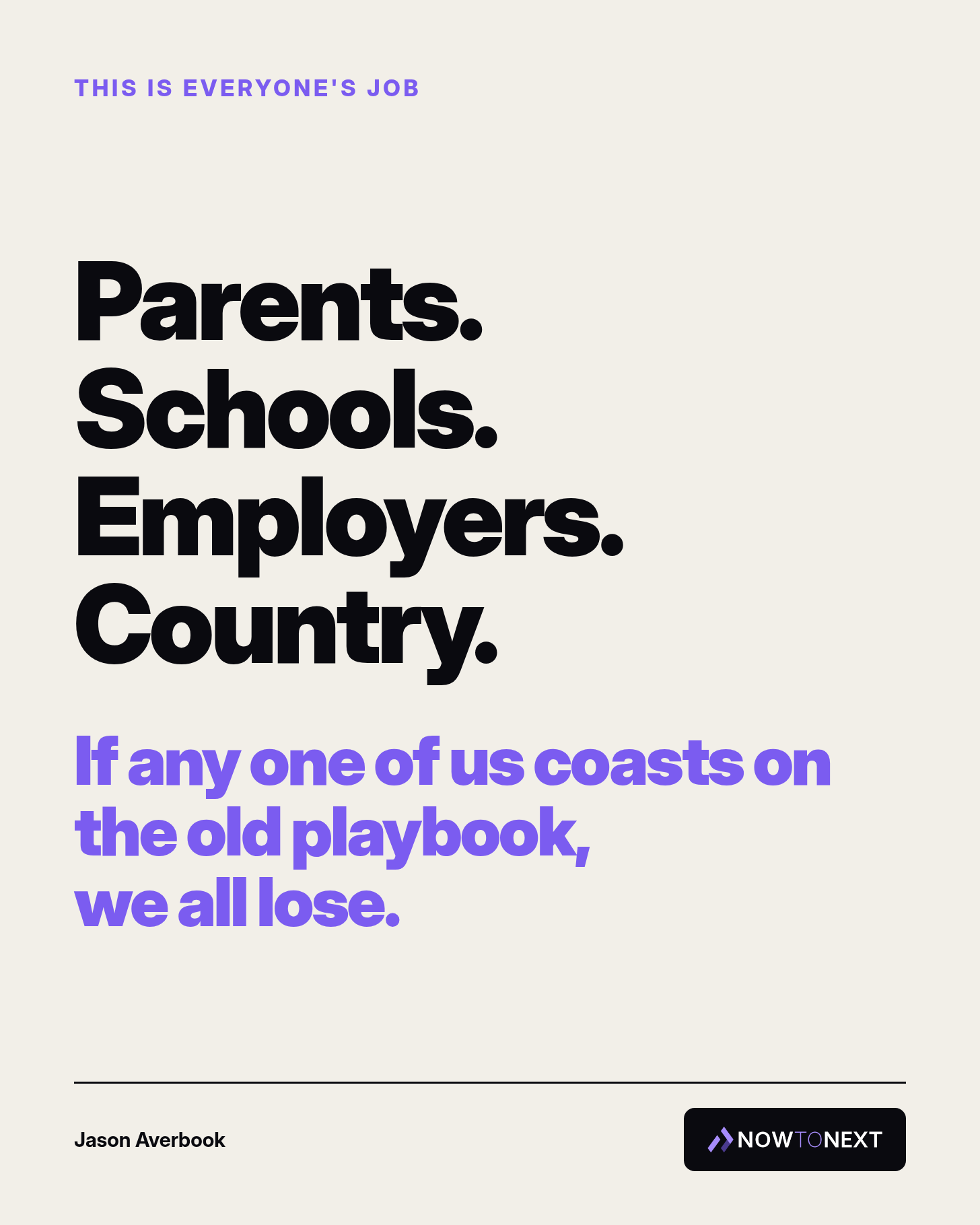
Waiting has consequences here too. A year without meaningful experience is a year somebody cannot simply recover later, and a student approaching graduation needs more than a promise that we are studying the future of work. Governments can help coordinate and fund the response, but employers, educators and families have responsibilities they can act on now.
Every country needs a plan for developing people alongside its plan for developing AI.
What will you commit to over the next 90 days?
At Now to Next, we have focused on hiring new college graduates, and that is our commitment to this issue. We want people at the beginning of their careers to have a real opportunity to contribute and grow. We also have work to do as we figure out how to develop people alongside technology that keeps changing, which is why I want to ask what you will commit to over the next 90 days.
If you are a leader, think about an opportunity you could create for someone who is not ready yet and who could help them become ready. If you are an employer, look at an early-career role and decide how AI can improve the work while the person gains judgment and responsibility. Those commitments need time for coaching, someone accountable for development and a way to see whether the person is becoming more capable.
If you are a teacher, consider how your students will practice with current technology, including agents, while learning to question it and think for themselves. If you are a parent, explore the technology with your kids and help them find experiences that build confidence, whether that is a paid internship or a summer job that teaches them to handle a difficult customer and be dependable to a team. We can all talk more openly about decisions we got wrong and the people who helped us improve.
I am asking each of us to choose something we can actually do, put a date on it and tell someone what we have committed to. In 90 days, we should be able to explain what changed and what we learned. National plans matter, but so does the decision to give a beginner an assignment, make room for an imperfect first attempt and stay involved long enough to help them get better.
A commitment to the future needs an owner, a date and a first step.
And to everyone reading this and thinking, “Jason, this is not easy,” you are right. Hiring beginners takes resources, coaching takes time, and changing how we teach requires support. Rethinking work also asks people to reconsider responsibilities, identities and assumptions they may have spent decades building. We need to recognize how much we are asking of people and give them the support to do it.
I believe this will likely be the biggest redesign of work and life we face in our lifetimes, reaching into how we learn, earn a living, raise our children, lead organizations and understand our own value. Nobody has the complete answer, including me, but we can make commitments and learn as we go. The class of May 2027 is approaching graduation while we are still discussing what the future might require.
At Now to Next, hiring new graduates is our commitment. As a leader, parent, teacher or employer, what will yours be over the next 90 days?
Now to Next.
P.S. Share your commitment in the comments, along with anything you are already doing that gives beginners meaningful experience. I want to bring those examples into follow-up pieces so we can learn from each other about what is working, what is difficult and what needs to change.
About Jason
Jason Averbook is the co-founder of Now to Next, an adjunct professor of business, and a globally recognized thought leader, advisor, and keynote speaker working at the intersection of AI, human potential, and the future of work. He spent the last few years as Senior Partner and Global Leader of Digital HR Strategy at Mercer, helping the world’s largest organizations reimagine how work gets done, not by implementing technology but by transforming the mindsets, skillsets, and cultures that have to come first.
Over the last two decades, Jason has advised hundreds of Fortune 1000 companies and their leaders, founded Knowledge Infusion and Leapgen, authored two books on the evolution of HR and workforce technology, and become a world renowned keynote speaker who has delivered hundreds of talks on the future of work. His work challenges leaders to stop treating digital transformation as an IT project and start treating it as a human strategy.
Through his Substack, Now to Next, Jason shares honest, provocative, and practical insights on what’s actually changing in the workplace, from generative AI to skills-based organizations to emotional fluency in leadership. His mission is simple: to help people and organizations move from noise to clarity, from fear to possibility, and from now to next.
You can reach him at jason@nowtonext.ai or connect on LinkedIn.