

I’m at parents’ weekend with my son Alex. I’ve been watching campus life, which is exactly what parents do at these things: students rushing somewhere, stopping to talk, and squeezing in a dinner while still making their new friend group.
It’s wonderful to see and if I’m honest, it also makes me uneasy.
My older son is here with us. He’s thriving in the work he’s doing, learning, exploring, curious about his next move. I love that he hasn’t decided there is only one next move. I also wonder what kind of workplace will make room for that curiosity when the pressure to deliver gets louder and how hard or easy that will be to find.
Next week I’ll be at the College of Charleston teaching as Entrepreneur in Residence. In the four weeks leading up to this one, I’ve been on the road in the U.S., Canada, and Southeast Asia. Different leaders, different industries, remarkably similar conversations. Eventually someone asks about the kids. Should they still go to college? What should they study? Will there even be a first job for them?
I hear parents say they feel sorry for this generation and not sure how they will afford their first house or make it in the workforce. I understand the instinct as many of us remember a clearer way into work, though it was never fair or easy for everyone. The students I’m watching are already trying to adapt. We’re the ones still writing “entry-level” beside a list of senior skills, then wondering why they aren’t ready. If we won’t change the jobs, the teaching, or the time we give managers to develop people, maybe the feeling we need isn’t sympathy, maybe it’s a little embarrassment.
I don’t feel sorry for this generation. I feel responsible for the world we’re inviting them into.
It’s interesting what happens when a CEO asks that question about their own child. We stop speaking in abstractions about “the talent pipeline.” We talk about confidence, opportunity, a decent manager, a chance to figure things out. Then we walk into a budget meeting and call someone else’s child’s first job an inefficiency.
That’s a hard sentence to write. It’s also why I do the work I do with enterprises and educational institutions. The care we feel for our own kids ought to survive the decisions we make about someone else’s.

The job already changed
I have read enough warnings that entry-level jobs may change. They have changed. Not in every industry, and certainly not all in the same way. But the assignments that introduced many of us to a profession are being done differently now, often with AI involved before a beginner touches them.
An AI tool can draft the first client memo, produce a first analysis, write code, summarize a customer history. Good. Sometimes that means a new employee can contribute faster. A study of customer support agents found that an AI assistant improved productivity most for novice and less-skilled workers. I think it is important for us to pretend those gains aren’t real.
But what did the beginner learn while the tool did the work?
Say a new HR analyst is asked why first-year employees are leaving. AI can summarize the exit interviews, sort the survey comments, and produce a clean set of recommendations. A more experienced colleague might ask who didn’t fill out the survey. Or whether the pattern changes by manager. Or why the AI keeps recommending a pay fix when people are really leaving because of a schedule nobody wants to change. The learning is in noticing that the tidy answer may be answering the wrong question, then having to do something about it.
AI has separated getting the work done from learning how to do the work. That’s the first-day problem.
PwC examined 2.4 million U.S. entry-level job postings and found that the roles most exposed to AI were seven times more likely than the least exposed roles to ask for skills usually associated with more senior people, such as leadership and creativity. A revised Stanford working paper found no evidence of widespread economy-wide displacement, but it did find a substantial relative employment gap among 22-to-25-year-olds in AI-exposed occupations. That isn’t proof AI caused every missing opportunity. It is a reason to take the first job seriously right now.
We are asking people to arrive with judgment before we’ve decided where they will get the practice to build it. Hell of a trick and one we wont succeed at alone.
The productive first year and the developmental first year are not always the same year. A company can celebrate the first and quietly realize that second is one they wont get a chance at as the person has already moved on.
Let’s define apprenticeship
I keep using that word, and I know it can sound like I’m talking only about the trades. I’m not.
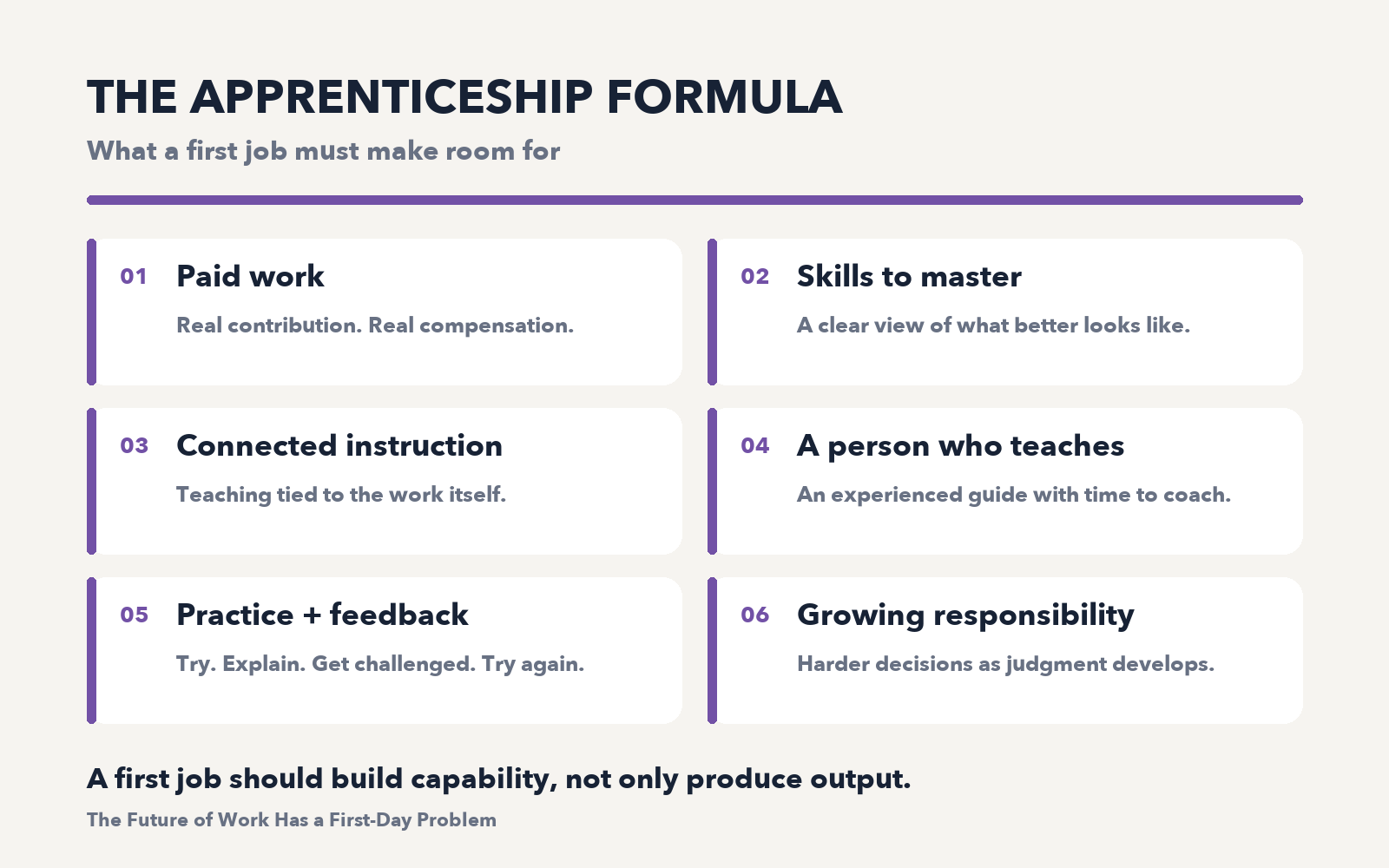
Here is the formula I have in mind: paid work + clear skills to master + instruction connected to the work + an experienced person who teaches + repeated practice and feedback + growing responsibility.
The person does useful work. They know what they are trying to get better at. Somebody watches how they think, not only whether they finish. As they improve, the work gets harder and their say in the decisions grows.
A formal U.S. Registered Apprenticeship has additional requirements, including structured on-the-job learning, related instruction, progressive wages, and a portable credential. I am also talking about bringing an apprenticeship approach into jobs that have never been called apprenticeships. We need to be precise about the difference.
Internships can be excellent. The National Association of Colleges and Employers calls for defined objectives, meaningful work, supervision, and feedback. A well-run summer internship may do all of that. What I want us to question is whether a few weeks of exposure, however useful, amount to a sustained commitment to develop someone into a capable practitioner. Sometimes they do not. Sometimes the intern simply finishes a project and leaves.
An internship can show someone the work. An apprenticeship makes a promise about who they will be able to become through doing it.
What are we teaching people to do?
Here is where I get impatient with the usual response. Someone says, “Great, we need to reskill everybody.” A deck appears. A course catalog appears. Perhaps a very expensive AI platform appears. And I want to ask: have we looked at the job yet?
How can we redesign learning if we haven’t redesigned the work? And how do we redesign a job when nobody can tell us exactly what it will be in five years?
I’m in the middle of building a detailed workshop for leaders around the question we keep skipping. Before debating headcount, let’s take a job apart and ask what work really is. Which tasks belong with a person? Which can a machine do? Where SHOULD not COULD the two work together, and who owns the result? A job is more than the tasks in its description. It carries decisions, relationships, accountability, and chances to learn. Subtract tasks without looking at those things and you’ve redesigned a spreadsheet cell, not a job.
When Jess Von Bank and I co-hosted a conversation with Dr. Vivienne Ming, she used a word I can’t get out of my head: “cyborg.” No implants or science-fiction costumes. She described people who work with AI throughout a problem. Some people take the machine’s answer. Others check it at the end. Her cyborgs bring curiosity, humility, and their own perspective into the exchange. What I take from her idea is a person who questions the answer, offers context the machine lacks, changes their mind when the evidence warrants it, and still owns the decision.
That is a useful definition for this moment. We keep drawing a line between work done by a human and work done by a machine. Many jobs will be built where that line moves throughout the day. The person has to know more than how to operate a tool. They have to know when it is solving the wrong problem. So the question I want leaders to face in the workshop is: How does a beginner become a good cyborg? Give someone a powerful machine without enough experience and context to challenge it, and we may have built speed without building capability.
Start closer to the ground. Take one role. Watch the work as it actually happens with AI, not as the process map says it happens (as we have always done). Ask which tasks have shifted, which decisions still require a person, and which early assignments used to teach something important. Bring beginners into this exercise. They will see uses for AI the experts miss (I love this digital-native; beginner mindset). The experts will see context and risk the beginners cannot yet know. Both groups should be learning.
Tony Moroney’s recent essay pushed me to think harder about one part of that practice. A beginner cannot be taught only to check whether AI’s answer is accurate. Someone also has to teach them to challenge the question they were handed. Why are we solving this problem? What did the prompt leave out? Who lives with the consequences if the recommendation is technically defensible and still wrong for the people involved? That kind of judgment grows when a manager lets a new person sit close enough to a real decision to see its messiness, then asks them to defend what they would do. Who is teaching the managers this? Maybe try this during the week instead of more Co-Pilot training?
Then build short cycles: try a workflow, observe where the person gets better or gets stuck, change the assignment, try again. If the work changes next quarter, the learning changes with it. That is more honest than pretending we can hand schools a permanent list of “future skills.”
AI can shorten a learning curve. It doesn’t excuse us from building one.

L&D (or whatever we want to call it) needs to be in this room
This also changes the job of learning and development. In the old arrangement, a business leader defined a role, asked L&D for training, and later counted completions. A lot of good people did serious work in that system. Courses still matter. But a course completion will not tell me whether a new employee can challenge an AI-generated answer in front of a customer, partner or make a decent decision when the easy cases have been automated which I am watching unfold in real life.
L&D needs to be there while the work is being designed. When AI takes over an assignment, ask: was that assignment only producing an output, or did it also give a beginner practice? If the practice disappears, where are we putting it back?
Take one role and make a 90-day learning agreement with its manager. Name two or three decisions a beginner should be able to make by day 90. Give them real cases, scheduled feedback, and more responsibility as they earn it. Sit in on a review. Listen to how they reason. Can they catch a weak assumption? Can they explain why they would reject a plausible recommendation? Do they know when to trust the AI and when to call a person?
Count the manager’s coaching time into this PLEASE. If we say managers are the teachers and then fill every hour of their week with delivery work, we’ve made teaching a nice idea instead of a job expectation.
The measure is not just “How many people took the AI course?” It is “Who can now do something they couldn’t do three months ago, and how do we know?”
A conversation I want CEOs to have
If you’re a CEO, ask your HR leader and CFO to bring you one entry-level role AI has already changed. Not a workforce strategy slide. One job. The actual work, the people doing it, and what has changed.
What did a beginner used to do? What do they do now? Which parts should a person handle, which belong with AI, and where do they need to work together? Who is accountable for the result? Which decisions will your experienced people be making three years from now, and who inside the company is learning to make them?
Then ask: Would I want my child to take this job? Would I believe they could grow here?
Your CFO is right to question more headcount. A first job that develops someone has to make business sense. But a headcount discussion that ends with this quarter’s total salary line misses the cost of hiring experience later, the time it takes that person to understand your customers, and the trouble you are in when your expert leaves and nobody is ready.
The role you remove today may be the expertise you cannot find tomorrow. Maybe your analysis shows a particular job should go. Thats great maybe but show me where its learning went.
And back to the what about college?
I understand why parents ask me whether their kids should still go. I am literally on a campus with one of mine while thinking about all this.
There is no honest universal answer. U.S. labor data still shows higher median earnings and lower unemployment for adults with bachelor’s degrees than for adults with only a high school diploma. There is no way that data can keep up with the pace of change today so realize, it is a look in the rear mirror window. That is an average, not an individual promise or an argument that every degree at every price is wise. College can also give people room to explore, peers who change their minds, and adults whose job is to teach. Watching Alex’s campus this weekend, I don’t want to wave any of that away.
I do want a better connection between learning there and work afterward. In Handshake’s Class of 2026 research, 58% of seniors said they would need stronger AI skills to succeed at work, while 28% said their academic program had meaningfully integrated AI. Schools have work to do. Employers do too. It is a bit radical for a company to demand “job-ready” graduates when it cannot describe how its own jobs have changed or give a graduate a first year in which to learn them.
Before asking whether graduates are ready for work, ask whether your work is ready to grow graduates.
One job, starting now
So here is the move I would make this week. Put the CEO, HR leader, CFO, L&D leader, and manager of one changed entry-level role in a room. Ask the manager to bring the last three real assignments that went to a beginner. Look at what the beginner did, what AI did, and what the person learned. If nobody can answer that last part, you’ve found the first piece of work.
I keep coming back to Alex on campus and my older son wondering, exploring and learning while thinking about what’s next. I cannot tell them what work will look like when they’re my age with any degree of certainty. I can tell them what I hope someone offers: a chance to contribute, room to get things wrong and better, an experienced person who gives a damn whether they learn, and a path that doesn’t vanish the moment a machine becomes faster at the first draft.
I want that for my kids. I want it for the students I’ll teach this week. And I want it for the person I’ve never met who is about to walk into their first day at a company whose leaders are deciding what AI should do.
That person doesn’t need our pity. They need us to have done the work.
The last thing I want to say is I know this is not EASY and I know it is EASIER SAID THAN DONE. That is OUR 2026-2027 challenge; no one is going to do it for us and I hope we care about the future more than we care about EASY.
The future of work has a first-day problem. Pick a first job and build a better first year for someone tomorrow. Moving from Now to Next.
About Jason
Jason Averbook is the co-founder of Now to Next, an adjunct professor of business, and a globally recognized thought leader, advisor, and keynote speaker working at the intersection of AI, human potential, and the future of work. He spent the last few years as Senior Partner and Global Leader of Digital HR Strategy at Mercer, helping the world’s largest organizations reimagine how work gets done, not by implementing technology but by transforming the mindsets, skillsets, and cultures that have to come first.
Over the last two decades, Jason has advised hundreds of Fortune 1000 companies and their leaders, founded Knowledge Infusion and Leapgen, authored two books on the evolution of HR and workforce technology, and become a world renowned keynote speaker who has delivered hundreds of talks on the future of work. His work challenges leaders to stop treating digital transformation as an IT project and start treating it as a human strategy.
Through his Substack, Now to Next, Jason shares honest, provocative, and practical insights on what’s actually changing in the workplace, from generative AI to skills-based organizations to emotional fluency in leadership. His mission is simple: to help people and organizations move from noise to clarity, from fear to possibility, and from now to next.
You can reach him at jason@nowtonext.ai or connect on LinkedIn.
Outstanding content, thanks Jason
The bit about redesigning the work before redesigning the training really landed. We keep asking people for judgment, then remove the small decisions and feedback that would help them build it. A first year should leave someone more capable, not just more productive.